The Other Thing You're Training
Intuition isn't a gift. It's a capacity — and it needs the right conditions to grow.
I came across an idea recently that I haven’t been able to stop thinking about.
Joseph Nguyen — author of Don’t Believe Everything You Think — was on Rick Rubin’s podcast Tetragrammaton (which totally sounds like a Transformers robot). I haven’t read the book. But something he said hit home.
Nguyen believes intuition lives at the intersection of three things:
Peace. Alignment. Growth.
Or put another way —
I feel safe. This feels like me. I am becoming.
In dance, the ability to trust your instincts is one of the most respected skills you can develop. But intuition isn’t innate — it isn’t some mystical gift you either have or you don’t. It’s a trained capacity. It’s built.
What we call a gut feeling is actually a layered system — several things happening simultaneously before you’re even conscious of it as a feeling at all. Your body sending physical signals. Your emotional state colouring your perception. Your nervous system scanning ahead, anticipating what’s coming. And most importantly, accumulated experience. Years and years of pattern-matching against everything you’ve lived through, felt through, moved through.
This is why your intuition might feel more reliable in the places where you have the most experience. It’s not magic. It’s information that’s been processed so many times.
Which brings me to what’s burning a hole in my brain when it comes to movement.
How often do people feel genuinely safe enough — in a fitness class, out in the world, in their own body — to let this capacity develop?
Because intuition needs conditions to grow. It needs an environment where experimentation is allowed. Where making a different choice isn’t humiliating. Where you’re encouraged to notice what you feel, not just execute what you’re told.
Nguyen’s framework makes a lot of sense to me. Peace is the psychological safety that allows you to build tolerance for what arises when you’re moving. Alignment is the recognition that what you’re doing actually resonates with who you are and what you value. And growth is the honest, subtle stretch at the edge of your current capacity — more than just the physical.
When the health and fitness environment only rewards physical execution — when the rules are framed as keep up, don’t question, push through, — you don’t build intuition. You override it. Over and over.
The invitation here is to think about the spaces you choose to move in. Do you feel empowered there, or small and incompetent? Does your instructor collaborate with you, or expect you to just comply? Is curiosity welcomed, or does it always feel like you’re doing something wrong?
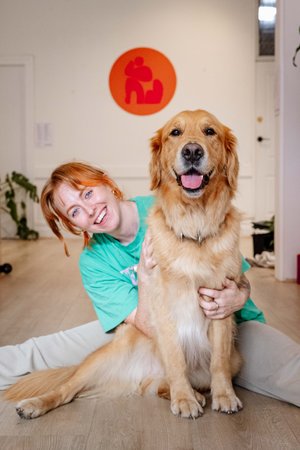
For me, intuition is a skill that helps me make the movement choices I make each day. It’s not about getting it right, but it’s about being in touch with your emotional, mental, spiritual and physical capacity. I know that when I’m feeling frustrated or tense, I need to get outside and walk with Bear. When I’m sore and stiff, I need to lift weights or get on the pilates apparatus. When my energy is low, I start slow, stay curious, and let my body decide before my brain does. When I’m feeling inspired and creative, I run — so my mind has the space to turn all of that energy into something.
Intuition is not certainty. Not a perfect read every time. It’s just a growing familiarity with your own signals — and enough trust in yourself to listen.
And that trust doesn’t come from being told to push harder. It comes from having space to feel whatever you feel without shame or comparison.