We are the stories we tell ourselves about ourselves.
While we can’t rewrite what we were told, we can choose exercise environments that help us tell a different story.
Not long after a devastating breakup, my personal trainer told me the best revenge is a revenge body. My high school crush told me in the middle of art class that I was disgusting because he could see wax in my ear. My dance teacher told my mum and I that I needed to shave my armpits before a ballet competition. Another told me to run around the block five times every day before class to lose weight.
It takes only a few seconds to leave a shame imprint on someone’s sense of self.
These types of comments can come from well-meaning places. But how they land depends on the vulnerability of the person receiving them and the care (or lack of it) in how they were delivered. Others come from people and institutions who carry a responsibility to do better by the communities they serve. Either way, this language became part of a story I began telling myself. That my body needed to look a certain way to be acceptable. That it was something to manage and perform for others.
The stories you tell yourself about your body rarely starts with you.
We are meaning-making creatures, wired to construct our sense of self in relation to others. Belonging isn’t just a want, it’s a biological need. Connection is both our deepest longing and our greatest fear. We crave it because it makes us whole, but we avoid it because it makes as vulnerable. So when someone of personal significance or authority speaks to us a certain way, it doesn’t arrive as neutral information we can take or leave. Research in developmental psychology shows that during our formative years, the words of caregivers, teachers, and peers are absorbed not merely as feedback, but as fact, shaping the inner narratives we carry into adulthood.
Shame is the fear of disconnection. When words carry shame, they don’t just sting in the moment. They can become identity. This is what I am. This is what I must be.
Shame about bodies doesn't only move person to person. It is also held inside systems.
The health and fitness industry — its imagery, its language, its architecture of success — has historically been built around a narrow idea of what a body should look like, what exercise is for, and who it belongs to. Weight loss as the default goal. Aesthetic transformation as the primary currency. Physical output prioritised above emotional safety and long-term wellbeing. This shows up not just in marketing, but in the design of spaces, the choices instructors make with language, the way programmes are built and delivered, and the spoken and unspoken assumption that certain bodies are more deserving of care than others. Body prejudice isn't only interpersonal. It's structural. And structural harm can't be undone by simply being kinder.
But underneath every shame message, there is still a person. With their own relationship to their body and how they move. Their own capacity to re-author their story. Their own nervous system, waiting to feel welcome enough in a movement space to try to re-write their narrative.
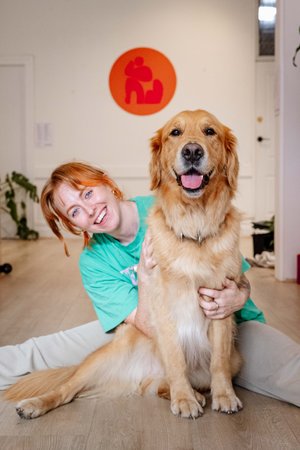
That's what I built Rosy Movement for.
Personal training courses and Pilates certifications teach you the mechanics — anatomy, heart, muscles, exercise science, output etc. What they often miss is why someone walks through the door to exercise in the first place. Or why they don’t. And what leads them to stay.
Studying exercise and sport science at degree level began to open the frame wider for me. Revealing the depth of human biology beyond anatomy and biomechanics, and the very real impacts of behaviour, culture, and structural forces that determine who has access to physical activity, why and how. Time inside high performance environments showed me that optimal results live in community and mindset just as much as in appropriate training loads. Immersing myself in weight-inclusive care, mental health first aid, and whole-person rehabilitation education has continued to expand what I understand injury and pain to mean. Not just physically but as lived experience.
Each step has revealed how much the fitness industry, for all its knowledge of hearts, muscles, and bones, still has so much to learn about the diversity of people living inside them. It troubles me daily that diet culture and misinformation continue to reduce movement to its most surface-level purpose. The transformation of appearance. When the process and the reward, goes so much deeper than that.
Rosy is built on the belief that you can have goals and dreams without shame, without body prejudice, and without the premise that you are broken and must first be fixed.
That intention, effort, and a genuine desire to grow don’t ask you to first agree that your apparent faults disqualify you from respect, understanding, or possibility.
What that looks like in practice is different for every single person who walks through our door. We all learn in different ways, and at different times. There is no singular right way to honour someone’s emotional wellbeing alongside their capacity to move.
What there is, always, is a a willingness to meet people exactly where they are.
We may not be able to dismantle the stigma just yet. But we can choose the spaces we move in. Ones that encourage people to be who they are. They inspire you to own your story, move with authenticity, and build something that belongs to you rather than to someone else’s idea of what you ‘should’ be.
There are so many extraordinary ways to move a body through the world. So many ways to build communities where emotional wellbeing and personal aspiration sit together, not in tension. Where the goal isn’t to arrive at a different body, but to come home to the one you already have.
Some might say this is asking too much of basic exercise education. Maybe. But if someone like me — white, cisgender, able-bodied, holding every advantage that society and the fitness industry favours — still has to search this hard to find movement spaces that genuinely do everything they feasibly can to ensure no one leaves feeling like a problem to be solved, then something important is missing. Not from the people walking through the door. From the industry waiting on the other side of it.